Who Bought $26 Billion of Anthropic Stock in a Private Deal? Nvidia, Google and Five Others
Seven chip and cloud companies paid the same $83 a share as the public, with no underwriter fee and no lock-up. The details are in an 8-K filed the day before Thanksgiving.
From SEC filings 8-K filed Nov. 25, 2026 · prospectus dated Nov. 18, 2026 · no share prices quoted here other than the $83 IPO price
On the afternoon before Thanksgiving, Anthropic filed a routine-looking report with the SEC. One section of it confirms the details of a second deal that closed alongside the IPO: on November 20, right after the IPO closed, the company sold another 313,253,007 shares in a private placement for about $26.0 billion.
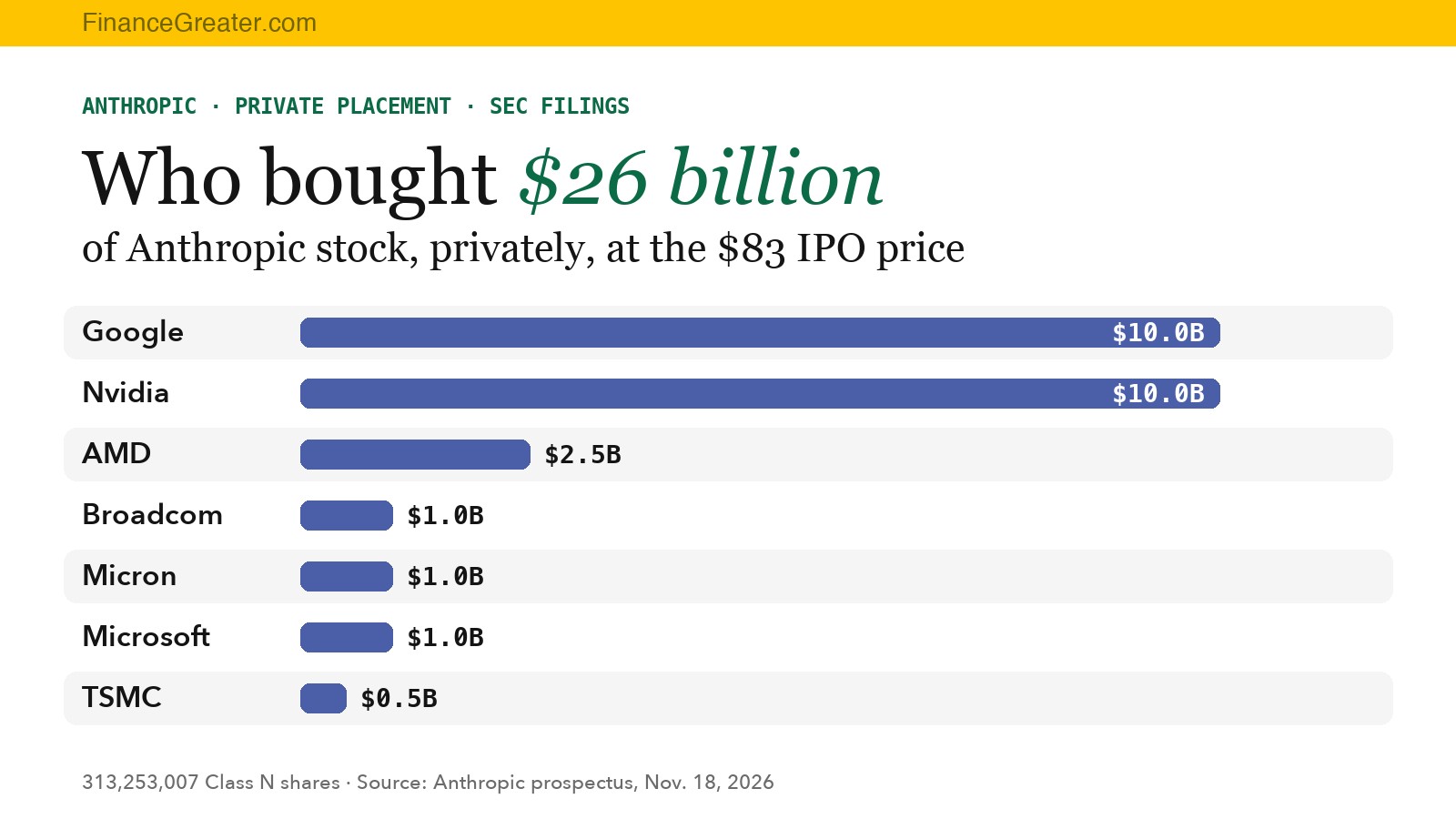
The buyers were not funds. They were seven of the companies that make or run the hardware AI depends on: Google, Nvidia, AMD, Broadcom, Micron, Microsoft and TSMC (through TSMC Partners, Ltd.).
They paid $83.00 a share, exactly what the public paid in the IPO. No discount.
The short version: Anthropic raised about $26.0 billion on top of its IPO by selling non-voting Class N shares to seven chip and cloud companies at the IPO price. Those shares have no lock-up with the underwriters, but they are restricted, so they cannot simply be sold on the open market right away.
Who bought, and how much
The prospectus lists each buyer's share of the deal.
| Buyer | Class N shares | Approximate amount |
|---|---|---|
| 120,481,927 | $10.0 billion | |
| Nvidia | 120,481,927 | $10.0 billion |
| AMD | 30,120,481 | $2.5 billion |
| Broadcom | 12,048,192 | $1.0 billion |
| Micron | 12,048,192 | $1.0 billion |
| Microsoft | 12,048,192 | $1.0 billion |
| TSMC | 6,024,096 | $500 million |
| Total | 313,253,007 | $26.0 billion |
Google and Nvidia account for about 77% of the total between them.
Two of the purchases were tied to earlier agreements, according to the prospectus. Google's was the full exercise of an option it already held under a financing agreement the two companies signed in March 2026. AMD's $2.5 billion counts toward a commitment of up to $5.0 billion that AMD made under a hardware supply agreement signed in July 2026.
What they bought: Class N shares
The seven buyers did not get the same shares the public trades.
- No vote. Class N shares have no voting rights, except where the law requires it.
- Same economics. The prospectus says the rights of Class A and Class N holders are identical except for voting and conversion.
- They convert when sold. Each Class N share turns into one ordinary Class A share when it is sold in a registered offering or on the open market, or transferred to a third party that is not already a Class N holder and would hold no more than 9.99% of any class.
The prospectus describes Class N holders as "primarily strategic business partners." Put plainly: these companies own a piece of Anthropic without a vote on how it is run.
How it fits with the IPO
The 8-K filed on November 25 gives the final IPO numbers.
| Shares | Price | Amount | |
|---|---|---|---|
| IPO, Class A (including the underwriters' full option) | 1,127,000,000 | $83.00 | about $93.5 billion |
| Private placement, Class N | 313,253,007 | $83.00 | about $26.0 billion |
| Together | about $119.5 billion |
Of the IPO shares, Anthropic sold 1,103,351,354 and existing stockholders sold 23,648,646. The company received nothing from the stockholders' sales. The $93.5 billion figure is our multiplication of shares by price; the $119.5 billion total is the company's own number, before fees and expenses.
Two details favor Anthropic. It paid no underwriting discount or commission on the private placement, so it received all of the proceeds. And the IPO did not depend on the private deal closing, though the private deal depended on the IPO.
The prospectus lists about 13.37 billion shares of all classes outstanding after the IPO and the private placement, assuming the underwriters' option was used in full, which the 8-K confirms. On that count, the private placement shares are about 2.3% of all shares outstanding. That percentage is our arithmetic, not a figure from the filings.
When can these shares be sold?
This is the part shareholders tend to ask about first.
- No lock-up. The prospectus says these shares are not subject to lock-up agreements with the underwriters or market standoff agreements with the company.
- But they are restricted. They were not registered, so they can be resold only under an effective registration statement or an exemption.
- The usual exemption has a waiting period. The prospectus says that, in general, once Anthropic has been a reporting company for at least 90 days, a buyer that is not an affiliate may resell under Rule 144 after holding the shares for at least six months. Affiliates face extra limits.
- Google has registration rights. The Class A shares that Google's Class N shares convert into are covered by its registration rights agreement, which lets Google ask Anthropic to register them for resale, subject to timing limits.
The prospectus also carries the standard warning that sales of a large number of these shares, or the belief that they could happen, could push the stock price down.
What we know, and what we don't
From the filings:
- The price, the share count, the seven buyers and each buyer's amount.
- The deal closed on November 20, immediately after the IPO.
- Anthropic says it plans to use the money from the IPO and the private placement for general corporate purposes, including compute and infrastructure, and hiring.
Not in the filings:
- Whether any buyer plans to sell, or when.
- What each company gets commercially beyond the two agreements the prospectus names.
- Anything about how ANT trades from here. This article quotes no market prices.
One more line in the same filing
The same section of the 8-K reports a second, much smaller sale. Just before the IPO closed, Anthropic sold one share of Class F stock to a company formed by its co-founders for $7.00. That single share carries 50.1% of the total voting power on matters put to stockholders generally. It has no economic rights, according to the prospectus.
What to watch next
- A resale registration. If Anthropic files to register these shares, or Google uses its registration rights, that is the first sign shares could come to market.
- The six-month mark. Shares bought on November 20 reach six months in late May 2027.
- Conversions. Class N shares that convert to Class A add to the ordinary share count.
- Ownership filings. Large holders report their stakes to the SEC, which would show whether any position changes.
- More deals like this. Private sales by other companies show up in the same kind of filing. We list them every day on our Stock Offerings page.
Primary sources and further reading
- Anthropic 8-K, filed November 25, 2026: Item 3.02 covers the private placement and the Class F share; Item 8.01 covers the IPO totals.
- Anthropic prospectus (Form 424B4), dated November 18, 2026: see "Concurrent Private Placement" and "Shares Eligible for Future Sale."
- Finance Greater: Stock Offerings: recent offering, shelf, IPO and private-sale filings in plain English.
This article is for information only and is not investment advice. Figures come from the company's SEC filings; where we did the arithmetic ourselves, we say so.